
AI Is More Than a Technology Issue—It’s a Corporate Responsibility Issue
By Mavis Brown
Recently, while teaching an Introduction to Business course, a classroom discussion on Corporate Social Responsibility (CSR) took an unexpected—and timely—turn.
Artificial intelligence quickly became the hot topic.
What began as a discussion about the responsibilities businesses have to their employees, customers, communities, and other stakeholders evolved into a much larger question:
What responsibility do organizations have when they choose to use AI?
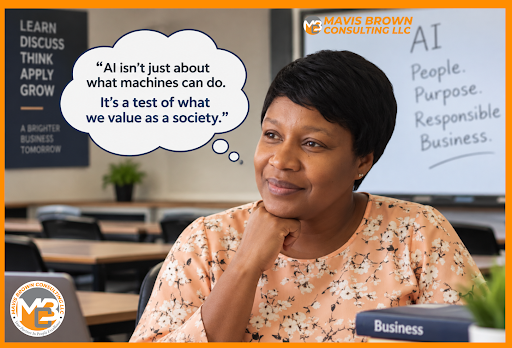
That conversation reinforced something I continue to think about in both the classroom and my professional work: AI isn’t simply a technology issue. It is increasingly becoming a corporate responsibility issue.
Moving Beyond What Can AI Do?
Organizations across industries are exploring artificial intelligence to improve efficiency, increase productivity, analyze information, automate processes, support employees, and make better business decisions.
Those opportunities are significant. But as organizations move forward with AI, the conversation cannot stop at:
What can AI do for our organization?
We also need to ask:
What responsibilities come with using it?
That second question moves AI beyond technology and places it squarely within conversations about leadership, ethics, workforce development, organizational culture, and corporate responsibility.
AI and the Changing Responsibility of Business
Corporate Social Responsibility has traditionally challenged businesses to consider how their decisions affect people and society—not simply their financial performance.
AI adds a new dimension to that responsibility.
When an organization introduces AI into the workplace, the impact can extend far beyond adopting a new piece of technology. It can change how employees perform their jobs, how managers make decisions, how customer information is handled, what skills workers need, and even how people experience their relationship with the organization.
This raises important questions for leaders:
Are employees being adequately prepared to work alongside AI?
How is employee and customer information being protected?
Are people able to recognize when AI-generated information may be inaccurate or biased?
Where should human judgment remain essential?
Is the organization transparent about how AI is being used?
Who is accountable when an AI-supported decision causes harm or produces an unintended result?
These are not questions for the IT department alone.
They are leadership and organizational responsibility questions.
Responsible AI Is Also a Workforce Issue
One aspect of the AI conversation that deserves particular attention is the workforce.
Organizations may see AI as an opportunity to improve productivity, but employees may experience the same change very differently. Some may see opportunity. Others may worry about job security, changing responsibilities, or whether they have the skills necessary to remain successful.
Responsible adoption should therefore include more than implementing technology.
Organizations should consider how they will communicate change, develop employee skills, prepare leaders, establish expectations, and create appropriate safeguards for AI use.
If businesses invest in AI without also investing in their people, they may overlook one of the most important elements of successful transformation.
Technology may enable change, but people ultimately determine how effectively that change becomes part of an organization.
Innovation and Responsibility Are Not Opposites
Organizations should not have to choose between innovation and responsibility.
In fact, responsible practices can help create the conditions for more sustainable innovation.
As an educator and workforce and organizational development professional, I am particularly interested in what AI adoption means for employees, leadership, ethics, privacy, workforce readiness, organizational culture, and decision-making.
Through my work in workforce and organizational development, I continue to explore an important question:
How can organizations embrace innovation while keeping people, ethics, and responsibility at the center?
That question will become increasingly important as AI becomes more integrated into everyday business operations.
Should AI Become Part of CSR Strategy?
Perhaps it is time for organizations to broaden the Corporate Social Responsibility conversation.
Responsible AI could become part of how businesses think about their obligations to employees, customers, communities, and other stakeholders.
That could mean establishing clear AI-use policies, protecting data, providing employee education and training, maintaining appropriate human oversight, evaluating potential bias, and creating accountability for AI-supported decisions.
The specific approach will vary by organization. But one principle should remain consistent:
The question should not only be whether we can use AI. We should also ask how we can use it responsibly.
As AI continues to reshape the workplace, corporate responsibility may increasingly be measured not simply by whether organizations adopt new technologies—but by how they manage the impact of those technologies on people.
As AI becomes increasingly embedded in how organizations operate, the question is no longer simply what AI can do—but what responsibility organizations have for how they choose to use it.
#ResponsibleAI #CorporateSocialResponsibility #WorkforceDevelopment #OrganizationalDevelopment #BusinessEthics #ResponsibleLeadership #FutureOfWork
